
Mudras For Digestive Problems
Have you ever finished a meal and felt that your belly suddenly doubled in size? Despite sufficient fibre on our plate, do we often experience sluggish digestion or that uncomfortable feeling of bloating?
If overlooked, bloating and poor digestion will make us appear ungainly and rob away our cheerful disposition.
How can we reverse this uncomfortable state in an efficient manner.
Yoga asanas like Vajrasana, forward bends, backbends and spinal twists massage the stomach and intestines and help the food within to breakdown and pass along the alimentary canal faster and more efficiently.
Remembering some basic yogic principles of not mixing too many different types of food at one go will ease this problem to a large extent. We must eat one or just a few complimentary types of food items at one time and give a time gap before consuming the next. For instance eat rice, lentils and one vegetable together in one sitting. We shouldn’t consume fruit and vegetables together or juice and milk at the same time.
We must keep in mind the golden yogic rule of keeping one quarter of the stomach empty at all times, to allow easy processing of food we have eaten.
Finally, yoga ‘Mudras’ help direct panic flow within, to ease digestive stress. Mudras are a subtle practice and they should be done consistently to produce results. Introduce Mudras for Digestive Problems into our lifestyle and expect results to slowly roll in.
Yoga mudras have been used in yoga practice as a technique to redirect panic flow within to benefit ailing body parts and promote healing and balance. When employed along with breathing exercises and a healthy routine, they can become an integral part of our daily wellness, ensuring a sound gut.
Mudras And Why They Are They Used in Yoga -
Mudras do not require a yoga mat, expensive tools or even an hour’s worth of free time. All we need is our hands, somewhere to sit and some quiet time. Mudras are different hand gestures that are practised by bringing the fingertips and thumb tip into different configurations with the intention of increasing or decreasing any of the five elements within us, of which we are composed. So, for instance a person lacks zest and energy, then they will be advised to do Mudras which increase the fire element within them. Conversely, another person may be extra hot tempered and would be told to perform a mudra which decreases their fire element.
Practising mudras provides us with an opportunity to relax, breathe and concentrate on ourself. By stimulating nerve endings linked to internal organs and activating the parasympathetic nervous system, mudras can assure us relief from symptoms like acid reflux, bloating and gas discomfort.
Which Mudra is Best for Digestion :- Here is a list of some of the mudras for digestive health that one can perform for a better gut -
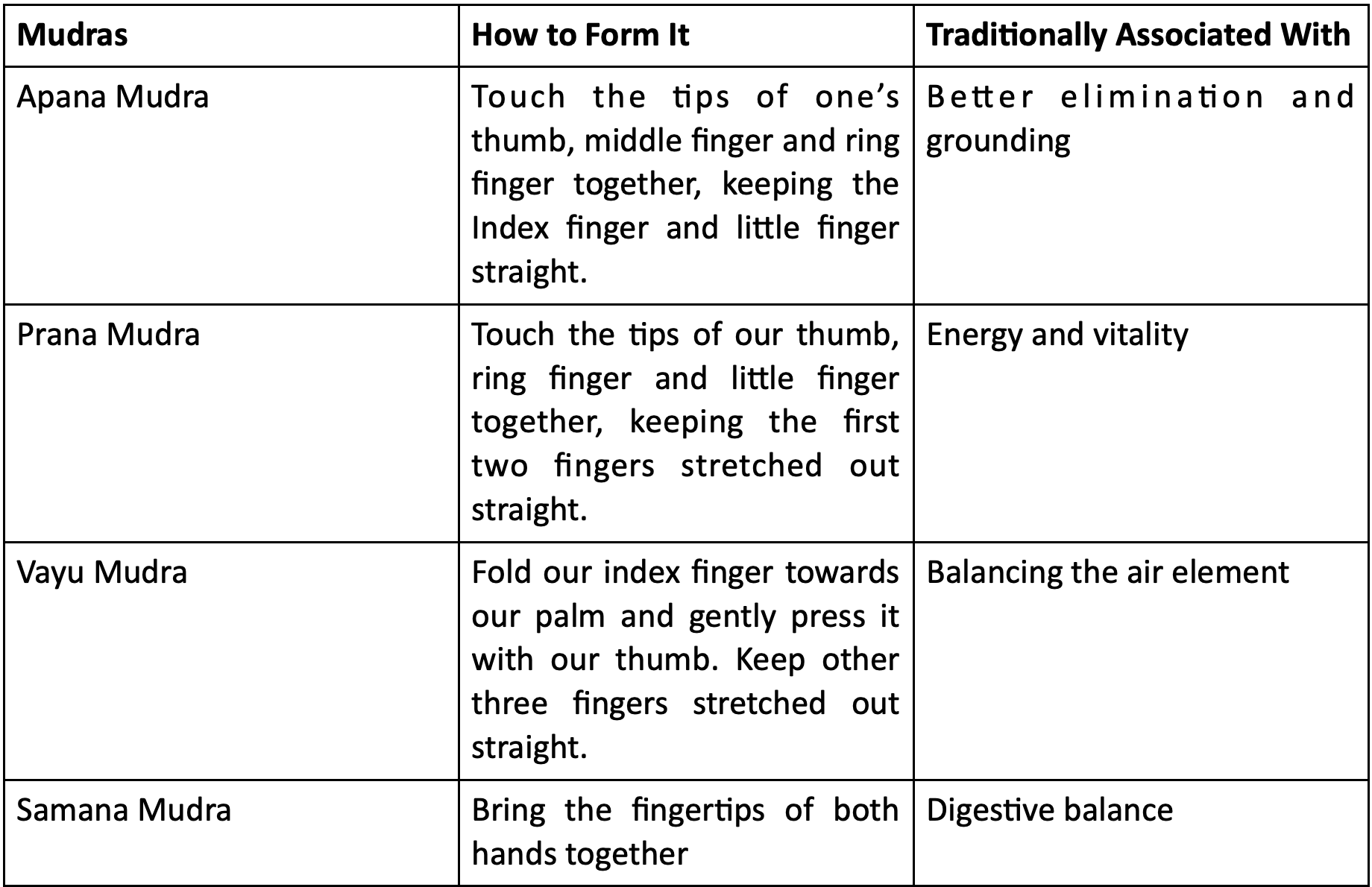
How To Practise Mudras for Better Digestion
The beauty of mudras for digestive problems lies in their simplicity. Without requiring any major set-up, one can practice them in the following manner for optimum results -
- Be seated comfortably with one’s back relaxed and spine upright.
- Make one’s chosen mudra gently without stressing one's fingers.
- Close one's eyes and breathe slowly.
- Continue practising for 5-10 minutes while focusing on rhythmic breathing.
- Conclude slowly and observe the effects on body and mind.
How Mudras Support Our Digestive Wellness
Mudras are not a magical solution to our digestive ailments rather they are a subtle way to heal our body and gut over a period of time. It is a simple technique that allows us to pause and reflect while the hand position stimulates desired energy flow. When combined with proper breathing, it can become a relaxing addition to our yoga practice, especially if we often feel heavy and bloated.
In yogic tradition, the various Mudras for Stomach Problems are concerned with the functions of digestion, elimination and balancing of elements in the body. Adopting a mindful approach and practicing these over time can make our gut wellness routine feel more intentional and effective.
Conclusion
Although bloating, gas, and indigestion might be uncomfortable experiences for us, our approach doesn't have to be complicated. The solution begins with mindful eating habits and including the practices of mudras, asanas and pranayama.
Mudras for digestive ailments provide a wonderful tool for bringing more consciousness to our yoga routine. Whether one is a beginner or an experienced yoga practitioner, simple hand gestures can become an integral part of our lifestyle.
So, let's include mudras in our exercise routine to embrace holistic well-being. Come to my studio Yoga with Sapna in Gurgaon and learn these key mudras right away.