Meditation and Yoga Studio in Gurgaon
While it’s true that, through a regular yoga practice, the strength of our body starts becoming apparent when we develop our ability to hold a pose longer, and challenge ourselves to increase repetitions but at its core, yoga is a practice of balance, awareness and mindful movement in which rest and relaxation play a very important role.
Do we find ourselves questioning: why is rest important in Yoga? Well, classical yoga has treated ‘rest’ as a discipline in itself for centuries and the Yoga Sutras of Patanjali has even described the ideal asana as ‘sthira sukham’ meaning a posture which can be held in a state of deep comfort.
Learning to pause is one of the most effective ways to understand how to be kind to the body in its innate form, and having been called the Best Yoga Classes in Gurgaon, we are going to address this topic earnestly.
Why Yoga Gives So Much Importance to Pausing
Every well-planned yoga session is an interplay between effort and release. When someone holds a pose with clenched jaws and shallow breathing, they lose the essence of the posture altogether.
On the other hand, short pauses, such as two natural breaths in Tadasana, or a minute in Balasana, make the heartbeat and breath settle back to a state of normal before the next sequence starts. Many practitioners are surprised to learn that these gaps are planned into a class; they aren't leftover time.
What Really Happens in the Body During Rest
Deep rest is far from idle guided relaxation moves the body towards its parasympathetic mode, which is the state linked with ease, repair and calm. A well-known study even found that endogenous dopamine release rose by 65% in experienced meditators. The group was small and made up of seasoned practitioners, but it hints that stillness is an active, measurable state of the brain, not a blank one.
In this state of ‘Shavasana’ the heart rate and blood pressure lower visibly, reducing stress hormones like cortisol and adrenaline. Mental noise and chatter quietens down, reducing anxiety and fatigue and simultaneously mental faculties like focus and memory get a boost. Due to deep relaxation of the heart and the nervous system, one is able to build emotional stability.
This period of rest after a long session of exercising, allows the muscles to experience deep release from tension and at the same time repair work happens at the cellular and tissue level. The rest period is short but it’s definitely a higher quality of rest due to the helpful guided suggestions made by the teacher, the brain gets triggered to wind down fully.
At the end of the ‘Shavasana’ relaxation, one experiences feeling both rested as well as energized.
Is Shavasana Really the Hardest Pose
‘Shavasana’, which literally translates to the ‘corpse pose’ or the ‘dead body pose’, looks like simply lying down, yet it demands that our relaxation is complete it asks the mind to stop managing everything. Unfinished emails, tomorrow's tiffin and that one awkward conversation should all queue up at the door. In fact, five to ten minutes can often feel like an eternity to a restless mind. Conventionally, Shavasana is kept at the end of a session so that the body can integrate everything that came before it.
To understand the significance of ‘Shavasana’ we could say that skipping this final relaxation is a bit like cooking a good dal / (lentil soup), but then taking it off the flame before the tadka / (seasoning).
Why Does Stillness Feel So Uncomfortable at First
Because most days reward speed.
A mind trained to tick off tasks reads stillness as idleness and the first few minutes of rest can bring restlessness, fidgeting, or even a sudden to-do list. That discomfort is not a sign of doing it wrong; it is the nervous system slowing down after hours of being on alert. With regular practice, the body begins to recognise the pause as safe, and settling happens faster.
One can start with just three minutes of quiet breathing at the end of a session, and that will be enough to allow the body to assimilate the benefits of the preceding stretches and vinyasas, in a calm relaxed state.
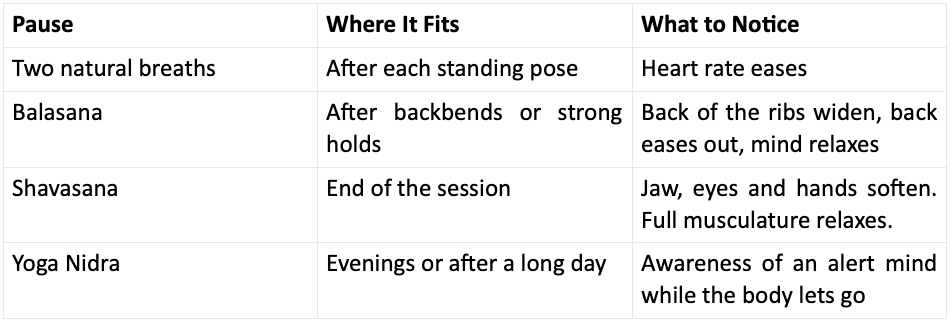
How to Pause Between Yoga Asanas
Pausing in yoga is a skill, and it improves with small, repeated habits. In fact, here's a simple guide that one can start with to learn the art of pausing.
Conclusion
Learning to rest is easier with an experienced teacher who builds it into the flow of a class. At YogawithSapna, we bring over 25 years of teaching experience to sessions that weave together asanas, vinyasas, pranayama, yoga nidra and meditation.
Still looking for a Meditation and Yoga Studio in Gurgaon? Book a trial class at YogawithSapna and discover how much a well-placed pause can enhance the practice.